

Resources

In this section, you can find a range of resources focusing on local governance of and service provision to irregular migrants. It is intended for authorities, policymakers, researchers, civil society and any other stakeholders interested in local initiatives on and service provision to irregular migrants. 

C-MISE resources: besides a comprehensive Guidance for Municipalities on local responses to irregular migrants, the C-MISE initiative has produced several briefings, reports, a webinar and a short documentary on city initiatives on service provision to migrants with irregular status, and related policies at EU and national level. A briefing on the impacts of COVID-19 on national and city policies on irregular migrants has been published in 2020. These can be found in the section below.

External resources: Following the list of C-MISE resources, you can find a collection of external publications on topics linked to the issue of focus of the C-MISE initiative. This collection was selected by the C-MISE team and is aimed at informing local authorities, policymakers, researchers, civil society and any other interested stakeholders in the issue of focus of the C-MISE initiative. This website only hosts links to external publications and resources selected by the C-MISE team on the basis of their relevance for city authorities interested in service provision to migrants with irregular status, and are only presented here as suggested readings. These external publications are the product of the authors there mentioned, and are not in any way the product of the C-MISE initiative, nor are they related or endorsed by the C-MISE initiative. As this collection is constantly evolving, the C-MISE team welcomes referrals for publications and resources that may be included in this list.

C-MISE resources

vertical background

Mentoring migrant children and youth, regardless of residence status (2021)

New short guidance for local authorities on community-based mentoring of migrant children and youth, regardless of residence status. Based on the experiences of the ‘Nightingale project' in Girona and Barcelona, this short guidance provides key learnings for other local stakeholders meaning to implement similar projects in their city. It offers information on potential models for mentoring programmes, responsibilities of local stakeholders (the city, universities, schools, and NGOs), costs and they key steps for a city to adopt similar programmes.

vertical background

Migrants with irregular status during the COVID-19 pandemic: Lessons for local authorities in Europe (2020)

The COVID-19 briefing offers a snapshot of how the pandemic impacted irregular migrants residing in European cities.

vertical background

The European Union and migrants with irregular status: opportunities and limitations in EU law and policy for European local authorities providing assistance to irregular migrants (2018)
This paper provides an analysis of how European Union (EU) legislation and policies might present challenges or offer opportunities for local authorities aiming to adopt initiatives responding in an inclusive manner to the social challenges brought by irregular migrants. 
screenshot 2021 02 25 at 18 00 28

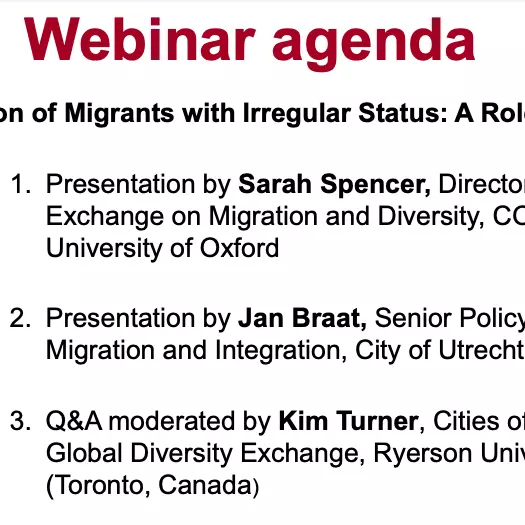
Cities of Migration - Webinar: Inclusion of Migrants with Irregular Status: a Role for Cities (2018)

A webinar organised by Cities of Migration to explain why and how local authorities in Europe have found ways to provide services and reach out to migrants with irregular status in order to build more inclusive cities for everyone. This webinar is part of webinar series organised by Cities of Migration and was presented by C-MISE co-director Sarah Spencer (COMPAS, Oxford University) and C-MISE chair representative, Jan Braat (City of Utrecht).
vertical background

European Cities and Migrants with Irregular Status: Municipal initiatives for the inclusion of irregular migrants in the provision of services (2017)

This report provides an overview of academic and policy literature findings on practices and policies that European municipalities have implemented to enable individuals with irregular immigration status to access some municipal services.

External resources

Oomen, B., & Baumgärtel, M. (2018). Frontier cities: The rise of local authorities as an opportunity for international human rights law.

Picture Credits

PICUM (2017). Cities of Rights: Ensuring Health Care for Undocumented Residents.

PICUM. (2007). Access to healthcare for undocumented migrants in Europe.

PICUM. (2008). Undocumented children in Europe: Invisible victims of immigration restrictions.

PICUM. (2011). Rights of accompanied children in an irregular situation.

PICUM. (2015). Protecting undocumented children: promising policies and practices from governments.vernments/

Pobjoy, J., & Spencer, S. (2012). Equality for all? The relationship between immigration status and the allocation of rights in the United Kingdom.

Price, J. & Spencer, S. (2014). City-Level Responses to Migrant Families with Restricted Access to Welfare Benefits.

Price, J. & Spencer, S. (2015). 'Safeguarding children from destitution: Local authority responses to families with 'no recourse to public funds''.

Provera, M. (2015). The Criminalisation of Irregular Migration in the European Union.

Research Hub

Listing text optional

Rosenberger, S. and Koppes, S. (2018). Claiming control: cooperation with return as a condition for social benefits in Austria and the Netherlands.

Sabates-Wheeler, R. (2009). The impact of irregular status on human development outcomes for migrants.

Scholten P., Kasli Z. (2018), Ask the expert policy brief - Integration.

Schweitzer. R. (2018). Health Care Versus Border Care: Justification and Hypocrisy in the Multilevel Negotiation of Irregular Migrants' Access to Fundamental Rights and Services.

Senyo Dotsey (2018) International migration and livelihood dynamics during the recent economic crisis: a study of Ghanaian migrants in the Como province, Italy.

Sigona, N., & Hughes, V. (2012). No way out, no way in: Irregular migrant children and families in the UK

Slaven, M. & Boswell, C. (2018): Why symbolise control? Irregular migration to the UK and symbolic policy-making in the 1960s.

Spencer S. and V. Hughes. (2015). Outside and in: Legal Entitlements to Health Care and Education for Migrants with Irregular Status in Europe.

Spencer, S. & Delvino, D. (2019). Municipal activism on irregular migrants: the framing of inclusive approaches at the local level.

Spencer, S. & Triandafyllidou, A. (2020). (Eds). Migrants with Irregular Status in Europe: Evolving Conceptual and Policy Challenges.

Spencer, S. (2013). City Responses to Migrants with Irregular Status.

Spencer, S. (2014). 'The Sunshine and Shadow Politics of Irregular Migrants in Europe'

Spencer, S. (2016). 'Managing Irregular Migrants within the EU'.

Spencer, S. (2016). Postcode Lottery for Europe's Undocumented Children: unravelling an uneven geography of entitlements in the European Union.

Spencer, S. (2018). 'Inclusion of Migrants with Irregular Status'. Building Inclusive Cities Case Study.

Spencer, S. (2018). Multi-level governance of an intractable policy problem: migrants with irregular status in Europe.

Spencer, S. (2020). Cities breaking the mould? Municipal inclusion of irregular migrants in Europe.

Spencer, S. (2022). European city network on migrants with irregular status: Exploring functions and outcomes on a sensitive policy issue