

Resources
In this section, you can find a range of resources focusing on local governance of and service provision to irregular migrants. It is intended for authorities, policymakers, researchers, civil society and any other stakeholders interested in local initiatives on and service provision to irregular migrants.
C-MISE resources: besides a comprehensive Guidance for Municipalities on local responses to irregular migrants, the C-MISE initiative has produced several briefings, reports, a webinar and a short documentary on city initiatives on service provision to migrants with irregular status, and related policies at EU and national level. A briefing on the impacts of COVID-19 on national and city policies on irregular migrants has been published in 2020. These can be found in the section below.
External resources: Following the list of C-MISE resources, you can find a collection of external publications on topics linked to the issue of focus of the C-MISE initiative. This collection was selected by the C-MISE team and is aimed at informing local authorities, policymakers, researchers, civil society and any other interested stakeholders in the issue of focus of the C-MISE initiative. This website only hosts links to external publications and resources selected by the C-MISE team on the basis of their relevance for city authorities interested in service provision to migrants with irregular status, and are only presented here as suggested readings. These external publications are the product of the authors there mentioned, and are not in any way the product of the C-MISE initiative, nor are they related or endorsed by the C-MISE initiative. As this collection is constantly evolving, the C-MISE team welcomes referrals for publications and resources that may be included in this list.
C-MISE resources

Mentoring migrant children and youth, regardless of residence status (2021)
New short guidance for local authorities on community-based mentoring of migrant children and youth, regardless of residence status. Based on the experiences of the ‘Nightingale project' in Girona and Barcelona, this short guidance provides key learnings for other local stakeholders meaning to implement similar projects in their city. It offers information on potential models for mentoring programmes, responsibilities of local stakeholders (the city, universities, schools, and NGOs), costs and they key steps for a city to adopt similar programmes.
The European Union and migrants with irregular status: opportunities and limitations in EU law and policy for European local authorities providing assistance to irregular migrants (2018)
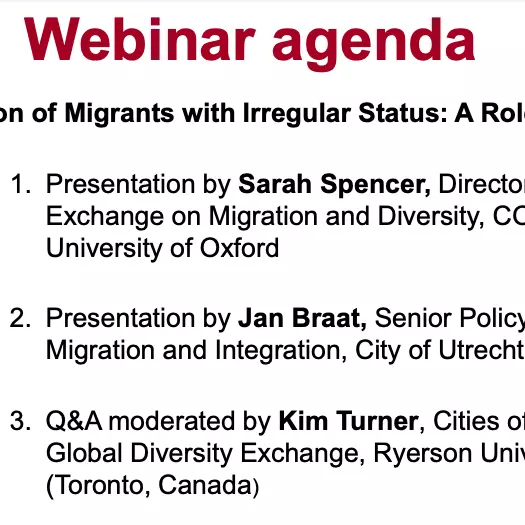
Cities of Migration - Webinar: Inclusion of Migrants with Irregular Status: a Role for Cities (2018)
European Cities and Migrants with Irregular Status: Municipal initiatives for the inclusion of irregular migrants in the provision of services (2017)
External resources